
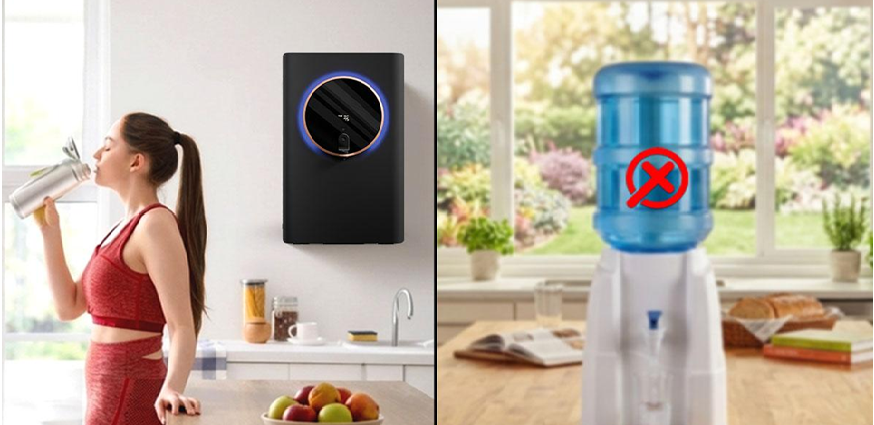
Generally, an ordinary water filter for home cannot deal with high TDS, dissolved salts, heavy metals such as lead or arsenic, or microbial contaminants such as bacteria and viruses.
That is where water purifiers with advanced and genuine filters becomes important. They feature reliable multi-stage purification and come with technologies like RO, UV, UF, Active Copper infusion and more. RO uses a semi-permeable membrane to reduce dissolved salts, TDS and certain heavy metals, while UV uses ultraviolet light to inactivate bacteria and viruses. UF provides another fine membrane filtration stage for suspended particles and certain microorganisms, and Active Copper Infusion enhances water with Copper, Zinc, Calcium and Magnesium for better taste and health. Filter maintenance matters too, since an overdue replacement can affect both water flow and filtration performance. So, before looking at RO water purifier price or any other water purifier’s price for that matter, check what is actually present in your water and choose the technology that addresses it.
When Does Your Water Need Advanced Purification?
● High TDS and Heavy Metals: When RO Is Relevant
Reverse osmosis (RO) uses a semi-permeable membrane to reduce dissolved salts, TDS, and certain heavy metals and chemicals. Leading products have RO range including, with some models designed for municipal, borewell, and tanker water up to specified TDS levels.
● Bacteria and Viruses: Where UV and UF Help
UV treatment uses ultraviolet light to inactivate microorganisms, while UF provides another fine membrane filtration stage. The best purification system combines these technologies in several models, including RO+UV+UF systems. Some models also use UV e-Boiling, a technology the brand positions as providing purification comparable to boiling for 20+ minutes.
How Your Water Source Changes What You Need
● Municipal Water
Municipal water is treated before it reaches homes, but its quality can still vary with the source and distribution network. It may contain chlorine, suspended particles or other impurities, so checking the water quality can help determine what kind of purification is needed.
Read More: How to Build a Reliable Network of Home Service Professionals
UV and UV+UF systems can be used for municipal and soft water with TDS below 200 ppm, while RO-based purification is suited to water with higher levels of dissolved impurities. The purification technology should match the quality of the incoming water.
● Borewell and Tanker Water
Borewell and tanker supplies can have higher TDS and dissolved minerals. That is where an RO-based system becomes more relevant. The actual water quality should guide the choice rather than the source alone.
Filter Maintenance: Why Genuine Filter Replacement Matters
- Replace Filters on Time to Maintain Performance
Filters collect impurities as they work, and their performance can reduce once they reach the end of their recommended usage period. Replacing them on time helps maintain water flow and the purifier’s intended filtration performance. Some newer water purifier systems also offer long-life filters, with stated limits such as two years or a specified litre volume under defined test conditions.
- Why Genuine Filters Matter
When it is time to replace a filter, choosing a genuine filter designed for your specific water purifier is just as important as replacing it on time. Genuine RO, UV, UF and combination filter kits are made to match the relevant purifier and its purification stages. Using the right replacement filter helps ensure compatibility and supports the purifier’s intended filtration performance, rather than treating every replacement filter as interchangeable.
Is an Ordinary Water Filter Safe for Drinking Water?
Usually, not. Though the type of purification you need depends on the water coming into your home.
TDS, dissolved impurities, and microbial contaminants can vary between water sources, so a water filter for home should be selected after understanding the water quality. Taste, odour and appearance alone may not tell you what is present in the water. But if your water contains dissolved impurities, comes from multiple sources or changes through the year, a multi-stage purification system with advanced and genuine filters offers broader protection by combining sediment filtration, activated carbon, RO, UV and UF into one integrated process.
Read More: The Evolution of Visual Cues in Public and Commercial Spaces
At the end of the day, the safest choice isn’t necessarily the purifier with the highest number of stages or the lowest RO water purifier price. It’s the one that’s designed for the water your family drinks every single day. And that’s a decision that’s always worth getting right.